

Why Is Bamboo Fiber Tableware Banned in Europe?
European border checks are seizing bamboo tableware at record rates, leaving B2B importers with frozen containers and stranded capital. Why did a seemingly eco-friendly product become a massive compliance liability?
Bamboo fiber tableware was banned in Europe because unauthorized bamboo powder mixed with melamine-formaldehyde resins led to toxic chemical migration exceeding EU safety limits at high temperatures, violating Regulation (EU) No. 10/2011.
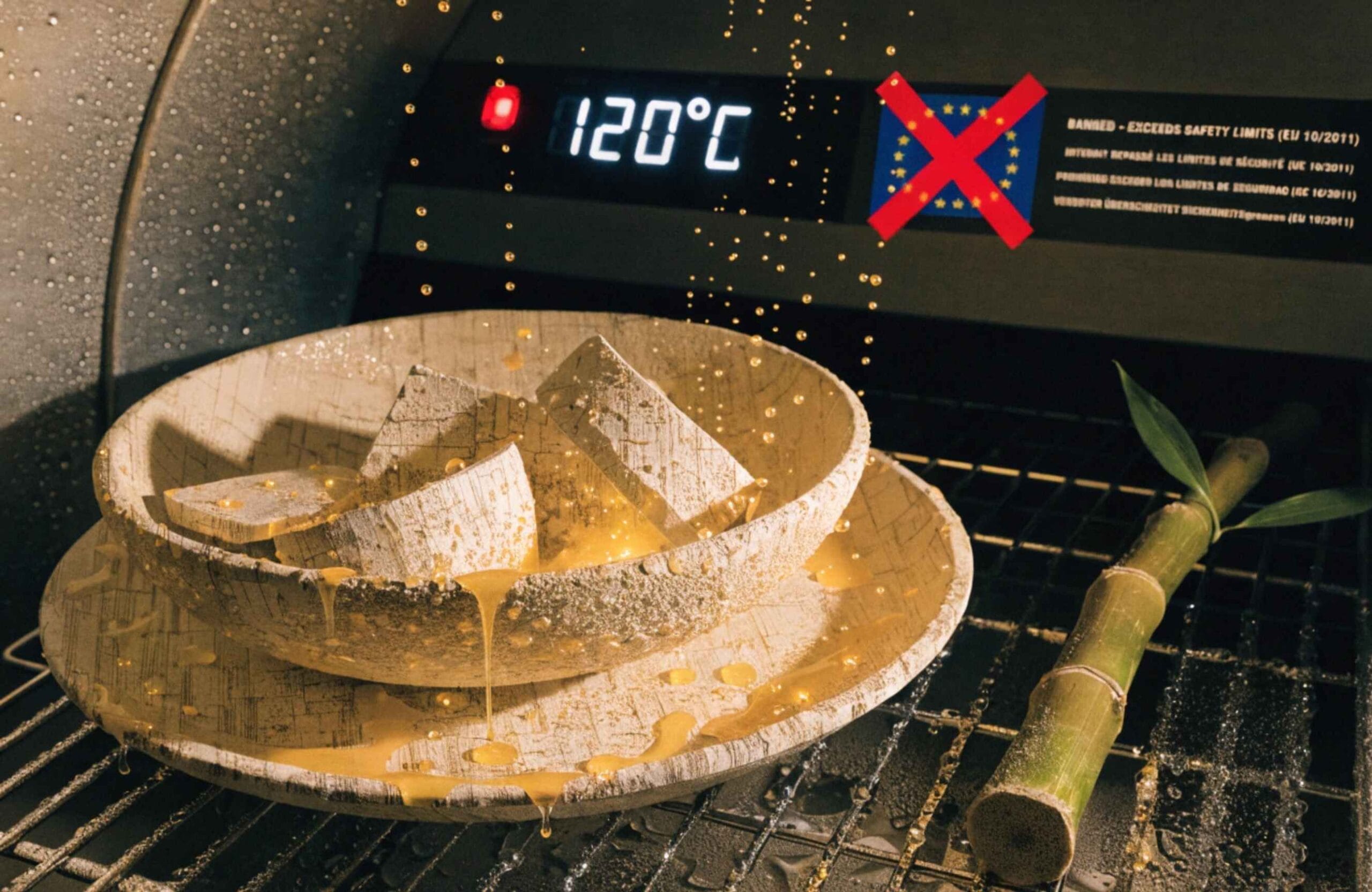
For over a decade at Aveco Group, we have exported food-contact tableware under strict EU and LFGB protocols. We watched this market collapse firsthand. The ban was not just a sudden legislative whim; it was a brutal but necessary market correction targeting compromised material science and reckless manufacturing shortcuts that contaminated the supply chain.
What is the core regulatory and material failure of bamboo-plastic composites?
You specify natural bamboo tableware, but lab tests return critical formaldehyde spikes. The structural reality of these composites reveals a dangerous disconnect between marketing claims and polymer chemistry.
The core failure lies in using unapproved organic fillers within a melamine matrix. Poor curing processes and thermal instability cause the polymer bonds to degrade, accelerating the migration of formaldehyde and melamine into food.
Deconstructing the "Bamboo Ware" Misnomer: What are these products actually made of?
The truth about "bamboo ware" is that it is predominantly melamine resin. Bamboo fiber acts merely as a cheap organic filler. Pure melamine products remain completely legal, safe, and heavily utilized in commercial dining when manufactured correctly. However, in these composites, factories blended bamboo powder with the melamine matrix.
From a frontline manufacturing perspective, if this bamboo-melamine composite is produced with strict temperature controls and proper curing times, it actually can meet food-grade safety standards. But to maximize margins, smaller, irresponsible factories compromised the molding process. They degraded the product quality by cutting curing times and altering chemical ratios, leading to massive failures in EU random testing. The European ban was essentially a harsh, one-size-fits-all penalty targeting this non-compliant production. Bad actors created market chaos, forcing the EU to implement a blanket ban. It is a stark reminder that safety and compliance require maintenance by the entire industry.
The Regulatory Breach: Why does bamboo powder violate EU Regulation (EU) No. 10/2011 on Food Contact Materials (FCM)?
EU Regulation 10/2011 operates on a strict positive list principle. Only explicitly authorized substances can be used as additives or polymer production aids in plastics intended for food contact. While certain wood flours are approved, ground bamboo is structurally different and was never assessed by the European Food Safety Authority (EFSA) for this specific composite use. By adding an unassessed organic filler to a plastic matrix, manufacturers violated the baseline authorization protocols, rendering the final product fundamentally illegal to import, distribute, or sell across European borders.
The Material Science Failure: How does bamboo filler compromise polymer stability and increase chemical migration?
When you mix an organic filler like bamboo powder with a rigid thermoset plastic, you introduce severe structural weaknesses. Bamboo powder naturally absorbs moisture and swells. Bound inside the melamine, this swelling creates micro-fissures in the polymer matrix. When exposed to high temperatures—such as holding hot soup or enduring a commercial dishwasher cycle—these fissures expand.
This thermal expansion disrupts the polymer network, failing to contain its chemical constituents. The result is the rapid, dangerous leaching of formaldehyde and melamine monomers directly into the food. This inherent material instability under heat is exactly why European lab samplings caught so many non-compliant batches.
What are the commercial risks for importers, distributors, and HORECA procurement?
Sourcing non-compliant composites isn't just a quality issue; it is a direct, quantifiable threat to your bottom line. Shipments are being actively destroyed at customs, and retailers face devastating legal liabilities.
Commercial risks include total inventory confiscation via EU enforcement actions, severe financial losses from mandatory product recalls, and legal liability for misleading consumers with false greenwashing claims.
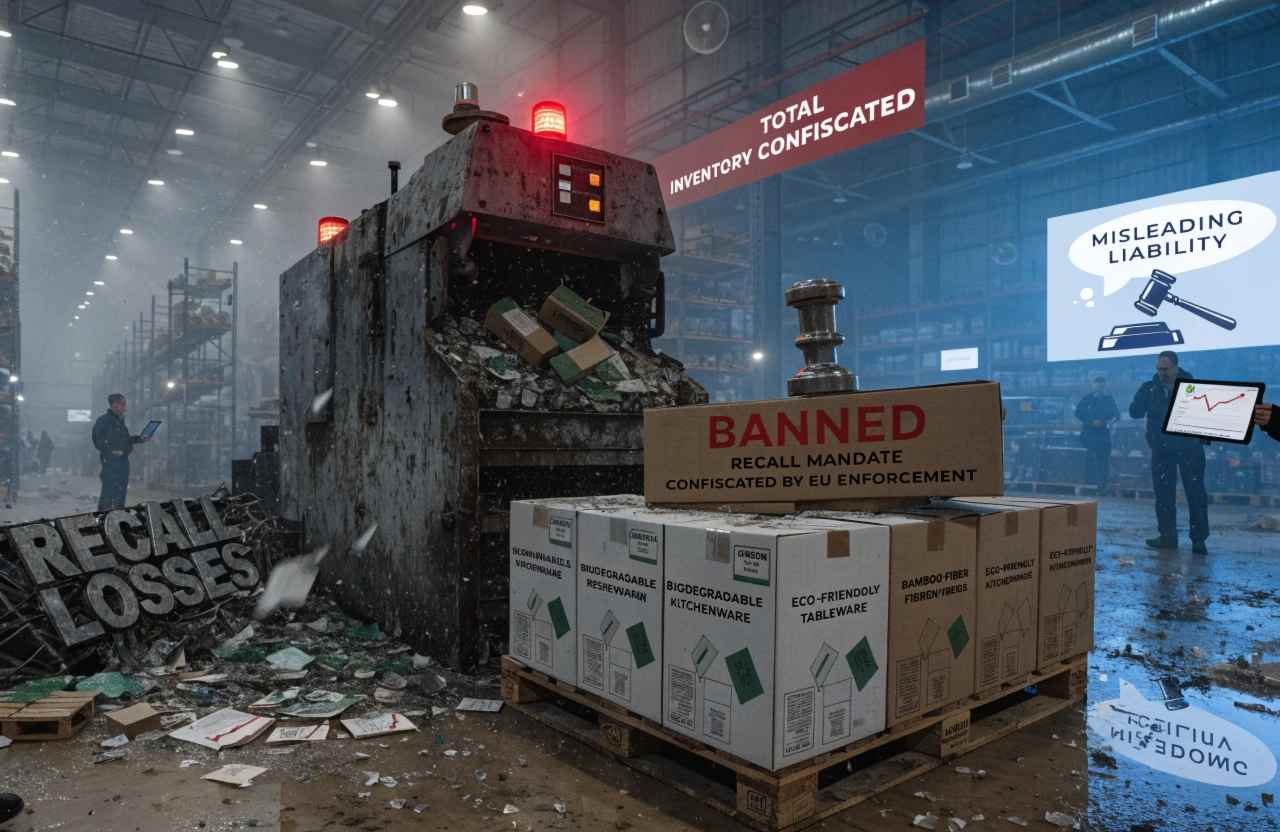
Supply Chain Disruption: Understanding the impact of EU-wide enforcement actions like "Bamboo-zling".
The European Commission’s coordinated action plan, officially designated to target plastic FCM made of bamboo powder, ordered customs and national authorities to aggressively target these shipments. For importers, this translates to zero tolerance at the border. Containers are flagged, tested, and systematically rejected at ports of entry. Procurement networks that relied on these materials found themselves paralyzed, realizing too late that this composite is now a permanently blacklisted material category within the European Union.
Financial & Reputational Damage: Quantifying the costs of product recalls, border rejections, and brand erosion.
The fallout from this policy did not just impact factories; it crippled brand owners. Bamboo-melamine tooling was cheap, allowing brands to launch new designs annually with minimal development costs. The ban destroyed this low-cost, high-margin model overnight, forcing urgent, expensive transitions.
Brands caught with legacy inventory now face mandatory recalls. The financial math is unforgiving: you lose the upfront injection tooling costs, the manufacturing deposit, the international freight, and you are billed for the incineration fees at the European port. Beyond these hard costs, B2B distributors risk permanently losing lucrative HORECA contracts when their provided tableware is publicly flagged as chemically unsafe.
The Liability of Misleading Claims: How "natural" and "eco-friendly" marketing creates legal exposure.
Labeling a product containing 60% melamine plastic as "100% natural bamboo" constitutes actionable consumer fraud under EU directives. Distributors face massive fines for deceptive greenwashing practices. As a direct manufacturing partner, we consistently advise our B2B buyers that material transparency is a non-negotiable requirement. Attempting to mask synthetic thermoset plastics behind botanical marketing terminology is precisely what drew regulatory scrutiny and triggered the enforcement actions.
What constitutes a compliant, high-performance, and truly sustainable alternative for commercial use?
The collapse of the bamboo composite market left a massive void in commercial diningware. Finding a replacement requires prioritizing certified polymer stability over cheap, untested botanical fillers.
Compliant alternatives rely on pure, traceable polymers like Food-Safe rPET or certified PLA bio-composites. They must pass strict LFGB and REACH migration tests and deliver commercial-grade thermal and impact resistance.
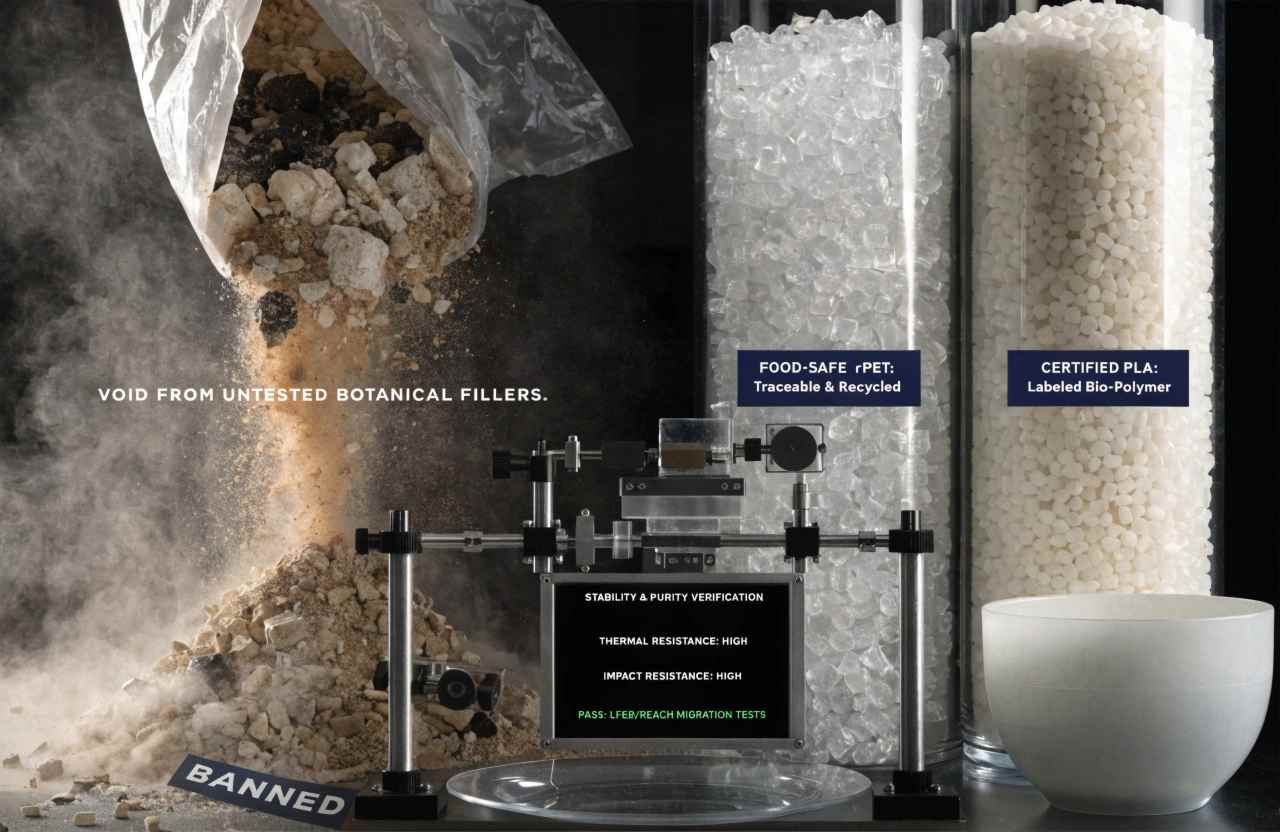
Beyond Fillers: The engineering principles of compliant bio-composites (PLA) and high-performance recycled polymers (Food-Safe rPET).
Moving away from illegal bamboo-melamine mixes requires proper polymer engineering. Polylactic acid (PLA) can be formulated into compliant bio-composites, provided that all secondary additives are strictly drawn from the EU 10/2011 positive list. Alternatively, high-performance recycled PET (rPET) offers a closed-loop, verifiable alternative. Instead of weakening a synthetic matrix with incompatible organic dust, these engineered polymers maintain tight, cross-linked molecular structures that inherently prevent chemical leaching.
| Material Profile | EU 10/2011 Compliance | Polymer Stability | Formaldehyde Migration Risk | Commercial Durability |
|---|---|---|---|---|
| Bamboo-Melamine Composite | Banned / Illegal | Poor (Micro-fissures) | Extremely High | Low (Degrades under heat) |
| Pure Melamine (Properly Cured) | Fully Compliant | Excellent | Low (Requires strict QC) | High |
| Food-Safe rPET | Fully Compliant | High | None | High |
| Crystallized PLA (CPLA) | Fully Compliant | Moderate-High | None | Moderate-High |
Food-Grade Precision: What certifications (LFGB, TÜV, REACH) are non-negotiable for ensuring safety and securing market access?
In our factory, we operate under the strict reality that paper certificates are useless without continuous, batch-level testing. To ensure uninterrupted market access in demanding regions like Germany or France, LFGB certification serves as the baseline. LFGB testing goes far beyond standard EU limits, utilizing rigorous sensory evaluations and extremely strict Specific Migration Limits (SML) for heavy metals and monomers. REACH compliance ensures no Substances of Very High Concern (SVHC) are present in the polymer matrix. Procurement teams must verify that the factory maintains these certifications continuously across actual production runs, rather than relying on a single, carefully prepped "golden sample."
Commercial-Grade Durability: How to evaluate materials for thermal stability, dishwasher resilience, and impact resistance in high-volume environments?
HORECA environments destroy poorly engineered materials. A compliant material must withstand commercial industrial dishwashers operating at 85°C without warping, blistering, or surface degradation. Material evaluation must scrutinize the Deflection Temperature Under Load (DTUL) and the Izod impact strength of the selected polymer. Materials like Food-safe rPET and crystallized PLA (CPLA) undergo highly specific annealing processes during injection molding to align their polymer chains. This thermal processing grants them the necessary mechanical toughness to survive high-volume commercial dining scenarios without failing.
Overcoming Heat Resistance Limitations in Bio-Plastics
Processing bio-based polymers for hot food contact often results in deformation. Standard PLA melts or warps at temperatures just above 60°C. We resolve this thermal instability through controlled crystallization and advanced blending techniques during the molding phase.
Achieving high heat resistance in bio-plastics requires nucleating agents and precise mold temperature control. This process transforms standard PLA into CPLA, raising its heat deflection temperature to over 90°C for safe microwave use and commercial dishwashing.
Crystallization Techniques for High-Heat PLA (CPLA)
Standard polylactic acid is amorphous. It lacks the crystalline structure required to withstand boiling water or microwave radiation. To alter this, we introduce nucleating agents into the polymer matrix before melting. The injection molding process must then operate at elevated mold temperatures, typically between 90°C and 100°C. This specific thermal window allows the polymer chains to arrange into a dense, stable crystalline lattice before the part cools and ejects. We meticulously control the cooling cycle time. Rushing the ejection process leads to incomplete crystallization, which inevitably causes post-mold shrinkage and severe warping in the final tableware.
Impact Modifiers and Structural Integrity
Increasing polymer crystallinity solves the heat resistance issue but introduces a secondary defect: brittleness. Highly crystalline PLA can shatter under direct impact. To counter this, material engineers blend bio-elastomers or mineral fillers like talc into the base resin. These impact modifiers absorb shock and distribute mechanical stress evenly across the polymer matrix. The result is a durable, reusable plate or bowl that survives drop tests and the aggressive handling typical in commercial catering environments. Consistency in the compounding ratio is vital. Over-saturating the mix with fillers degrades the material's structural integrity and risks compromising food-contact compliance.
Navigating compliance for food-contact tableware can delay production and stall global shipments. Failing to meet strict European migration limits triggers immediate product recalls and destroys buyer trust. Understanding the technical nuances between regional standards prevents costly rework on the factory floor.
Compliance in food contact materials hinges on strict migration testing protocols. While the FDA often relies on raw material approvals, the EU requires Overall Migration Limits (OML) and Specific Migration Limits (SML) testing on the finished product under varying heat and acidic conditions.
EC 1935/2004 vs. FDA Compliance
The regulatory frameworks in Europe and the United States mandate distinctly different manufacturing protocols. The FDA (CFR Title 21) largely evaluates the chemical formulation. If the base polymers, colorants, and additives are on the Generally Recognized as Safe (GRAS) list or possess prior sanction, the material is generally deemed compliant. The European Union operates under a stricter doctrine via EC 1935/2004 and Regulation (EU) No 10/2011. The EU framework operates on the physical reality that processing changes the chemical nature of the material. Therefore, the finished, molded product must undergo rigorous laboratory testing to physically prove that harmful substances do not transfer into food under real-world conditions.
| Regulatory Standard | Core Focus | Primary Testing Requirement | Approach to Additives |
|---|---|---|---|
| EU (EC 1935/2004) | Finished product safety | OML and SML testing with liquid simulants | Strict positive list with defined migration thresholds |
| US FDA (21 CFR) | Raw material formulation | Extraction testing on base polymer resins | Relies on GRAS list and Food Contact Notification (FCN) |
| Germany (LFGB) | Sensory and chemical safety | Odor/taste transfer, advanced peroxide testing | Highly restrictive; significantly exceeds the standard EU baseline |
Managing Overall and Specific Migration Limits (OML/SML)
Controlling chemical migration starts directly at the injection machine barrel. High shear rates or excessive barrel temperatures can degrade polymers, creating low-molecular-weight fragments that readily migrate into food. We test against a strict Overall Migration Limit (OML) of 10 mg/dm². Furthermore, we test Specific Migration Limits (SML) for individual monomers, heavy metals, or plasticizers. Testing involves exposing the tableware to chemical simulants like 3% acetic acid or 50% ethanol at 70°C for two hours. If the polymer matrix is unstable due to poor processing parameters, the product will fail. Maintaining strict thermal stability during mass manufacturing is the only reliable method to ensure ongoing compliance.
Scaling Precision Manufacturing for Tableware
Scaling production for reusable tableware frequently exposes hidden structural flaws. Thin-wall designs suffer from warpage, flash, and uneven cooling when cycles are rushed. High-tonnage injection machines paired with optimized tooling parameters eliminate these inconsistencies during continuous production.
Consistent precision manufacturing relies on uniform cooling channel design and optimized injection pressure. Proper mold flow analysis prevents flow marks, warpage, and dimensional instability during high-volume production runs.
Mitigating Warpage in Thin-Wall Injection Molding
Thin-wall tableware requires exceptionally high injection speeds to fill the cavity before the material freezes. However, rapid injection induces severe shear stress. When the part cools, this residual stress releases, causing the plate or bowl to warp. We mitigate this by balancing injection speed with precise, multi-stage packing pressure. The packing phase forces additional plastic into the cavity to compensate for polymer shrinkage as it transitions from a molten state to a solid. Gate size and location are equally critical variables. A restrictive gate stifles material flow, leading to premature freeze-off and visible sink marks. We utilize hot runner systems with automated valve gates to maintain optimal melt temperature directly into the cavity, ensuring uniform part density.
Defect Reduction Through Mold Flow Analysis
Before cutting steel for any new tableware mold, we execute comprehensive mold flow simulations. This computational software maps exactly how molten plastic will fill the cavity, predicting potential defects before physical production begins. It identifies the exact locations of weld lines—the areas where two plastic flow fronts meet. If weld lines occur in high-stress areas of a cup or tray, the product will fracture under operational pressure. The analysis also highlights potential air traps, which cause diesel burns on the product surface. By analyzing these variables computationally, we adjust the tooling design, optimize venting points, and configure conformal cooling channels to guarantee every production batch meets strict dimensional tolerances.
Conclusion:
Manufacturing safe, compliant food-grade tableware requires strict adherence to polymer science and processing parameters. Mastering material properties, from crystallization processes to migration control, ensures high-volume production meets rigorous global safety standards. Reliable manufacturing relies on consistent engineering practices rather than theoretical shortcuts.