

Is rPET Safe for Food Contact in Europe?
European buyers constantly question if recycled plastics belong on a dining table. Contamination fears drive hesitation, yet avoiding sustainable polymers means missing out on circular economy demands.
rPET is fundamentally a plastic polymer that is completely safe for food contact when processed compliantly. Through rigorous decontamination and adherence to EU regulations, rPET tableware achieves strict food-grade safety, easily passing European standards like LFGB and EC 1935/2004.
![[image placeholder]](https://avecodinnerware.com/wp-content/uploads/2026/05/glass-bowls-pasta-salad.webp "[image placeholder]")
Understanding the safety of recycled polyethylene terephthalate (rPET) requires stripping away the marketing noise and looking straight at the polymer science and legal frameworks. It is not about whether the base resin is recycled; it is about the thermodynamic and mechanical validation applied during extrusion and molding. We cannot simply label rPET as inherently "safe" or "unsafe." Like any virgin plastic material, achieving food-grade status depends entirely on employing compliant, scientifically verified manufacturing practices. When engineered correctly, the resulting tableware consistently passes the strictest European food safety regulations.
What Is the EU's Regulatory Framework for Food-Grade rPET?
Navigating European plastic regulations is notoriously complex. One misstep in understanding the legal requirements can lead to delayed shipments, failed customs inspections, and recalled product lines across multiple borders.
The EU governs recycled plastics through Regulation (EU) 2022/1616 and (EU) 10/2011, mandating that all rPET undergoes decontamination through an EFSA-assessed process to ensure migration levels remain strictly below threshold limits, safeguarding human health.
![[image placeholder]](https://avecodinnerware.com/wp-content/uploads/2026/05/plastic-recycling-eu-standards.webp "[image placeholder]")
Decoding Commission Regulation (EU) 2022/1616: The Cornerstone of Recycled Plastic Safety
Regulation (EU) 2022/1616 replaced the older 282/2008 framework, establishing tighter controls over how plastics are collected, decontaminated, and repurposed for food contact. From a manufacturing standpoint, this regulation demands that recycled plastics are only produced using "suitable recycling technologies." For PET, this means mechanical recycling processes must be explicitly authorized. The regulation requires comprehensive quality assurance systems at the facility level, ensuring that the input material consists of at least 95% food-contact origin plastics. We treat this as a non-negotiable baseline. Factories must implement strict sorting parameters, as the regulation prohibits the blending of industrial chemical containers with food-grade plastic streams.
The Role of EFSA: How Are Decontamination Processes Scientifically Assessed for Efficacy?
The European Food Safety Authority (EFSA) does not simply take a supplier's word for material purity. Before a decontamination process can be authorized under EU law, EFSA evaluates the technology's capability to strip away chemical residues. This assessment analyzes the specific processing conditions—such as vacuum pressure, temperature, and residence time in the reactor. The goal is to mathematically prove that the applied thermodynamic stress reliably removes potential volatile and semi-volatile contaminants that the post-consumer plastic may have absorbed during its previous lifecycle.
Even after successful decontamination, the final rPET tableware must comply with the migration limits set by Regulation (EU) 10/2011. This involves subjecting the finished molded product to harsh chemical simulants like 3% acetic acid and 50% ethanol at elevated temperatures.
| Metric | Definition | Factory Application & Testing Focus |
|---|---|---|
| OML (Overall Migration Limit) | The maximum permitted amount of non-volatile substances released into food. Limit: 10 mg/dm². | Ensures the polymer matrix does not physically break down or dissolve into hot or acidic foods during repeated use. |
| SML (Specific Migration Limit) | Maximum permitted quantity of a specific heavy metal or monomer (e.g., Antimony, Terephthalic acid). | Dictates strict temperature controls during injection molding to prevent thermal degradation and monomer release. |
| NIAS (Non-Intentionally Added Substances) | Impurities, reaction intermediates, or breakdown products not actively added to the plastic. | Requires advanced gas chromatography-mass spectrometry (GC-MS) to detect unpredictable trace compounds from the recycling stream. |
Monitoring NIAS is particularly critical in recycled materials. As an experienced manufacturer, we focus heavily on optimizing injection parameters to prevent thermal degradation, which is the primary trigger for the formation of unwanted NIAS in finished tableware.
How Does 'Food-Grade Precision' Apply to rPET Manufacturing?
Even with compliant resin, poor factory execution ruins the final product. Contaminated extrusion lines or incorrect temperature controls can degrade the polymer chain, rendering the tableware unsafe for food.
Food-grade precision in rPET requires strict input stream validation, advanced thermal decontamination, and specialized injection molding protocols that prevent polymer degradation, ensuring reusable tableware meets structural and chemical safety standards.
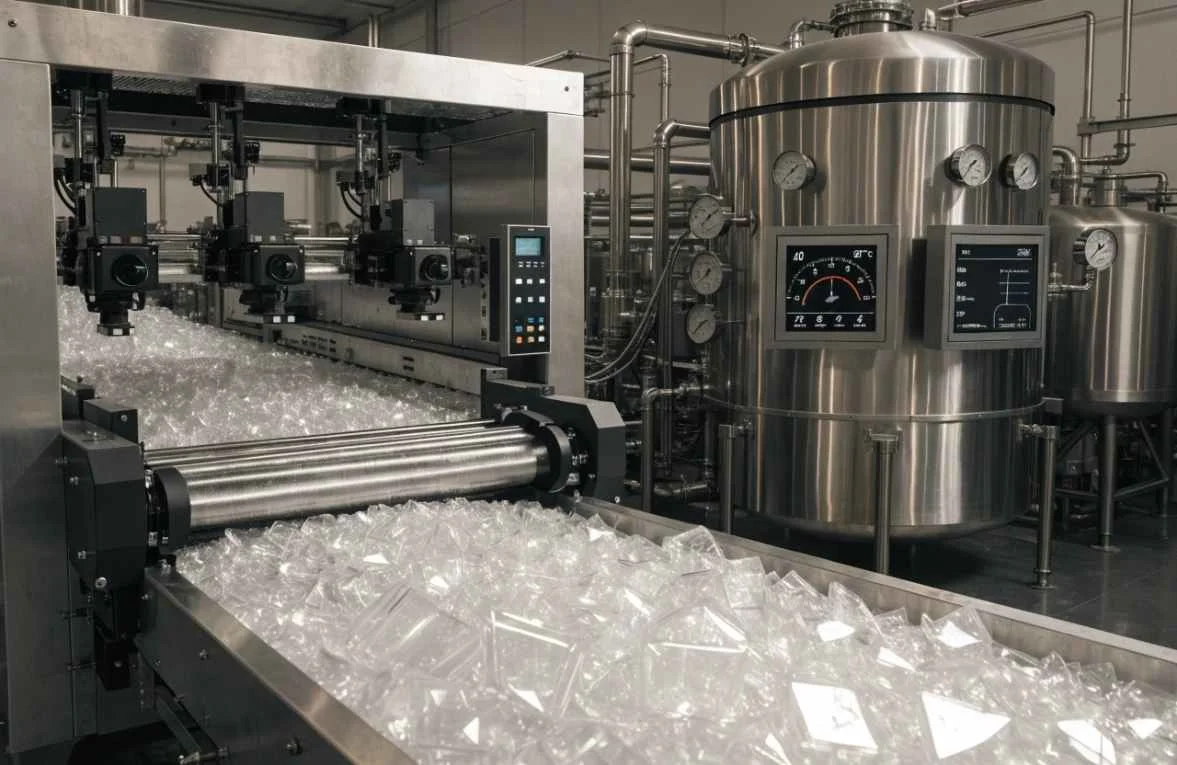
Input Stream Validation: The Critical First Step in Ensuring Polymer Purity
The integrity of rPET tableware begins long before the plastic enters the mold. Input stream validation is the filtration process that determines whether the raw material is viable for food contact. Post-consumer PET bales must be aggressively sorted using near-infrared (NIR) optical technology to separate non-PET plastics (like PVC or PP) and non-food containers. When we engineer our tableware, we operate on the fundamental truth that rPET is just a plastic base; its safety is completely dictated by this initial screening. If the input is compromised, no amount of downstream processing can legally or chemically force it into compliance.
Decontamination Engineering: A Technical Look at Thermal, Vacuum, and Solid-State Polycondensation (SSP) Processes
To transition sorted PET flakes into food-safe resin, the material undergoes Solid-State Polycondensation (SSP). This is a highly technical thermodynamic process where the plastic is subjected to high heat (typically between 200°C and 220°C) under a deep vacuum or inert gas flow for up to 12 hours. This serves a dual purpose. First, the heat and vacuum aggressively extract deeply embedded contaminants. Second, SSP rebuilds the polymer chains, increasing the intrinsic viscosity (IV) of the plastic. Restoring the IV is crucial because mechanical recycling naturally degrades the molecular weight of PET, and a higher IV is required to achieve the mechanical strength necessary for durable, reusable tableware.
From Polymer to Plate: Why Safety Protocols for Reusable Dinnerware Exceed Those for Single-Use Packaging
Most rPET is utilized in single-use water bottles, but manufacturing reusable dinnerware requires an entirely different engineering approach. Reusable plates, cups, and bowls are subjected to rigorous commercial dishwashing cycles, prolonged exposure to boiling liquids, and aggressive mechanical impact. Consequently, our injection molding parameters are strictly controlled. We manage the melt temperature and mold cooling times with extreme precision to minimize internal stress and maximize crystallinity. High crystallinity prevents the tableware from warping or releasing micro-plastics under thermal shock, ensuring the material remains chemically inert over years of repeated use.
What Verifiable Metrics Define 'Sustainable Compliance' for rPET Tableware?
Claims of "eco-friendly" or "food-safe" mean nothing without hard data. Relying on supplier promises instead of scientific testing exposes your brand to massive legal and reputational risks.
Sustainable compliance is validated through independent LFGB testing, rigorous challenge testing during the decontamination phase, and end-to-end supply chain traceability proving the material's origin and continuous chain of custody.
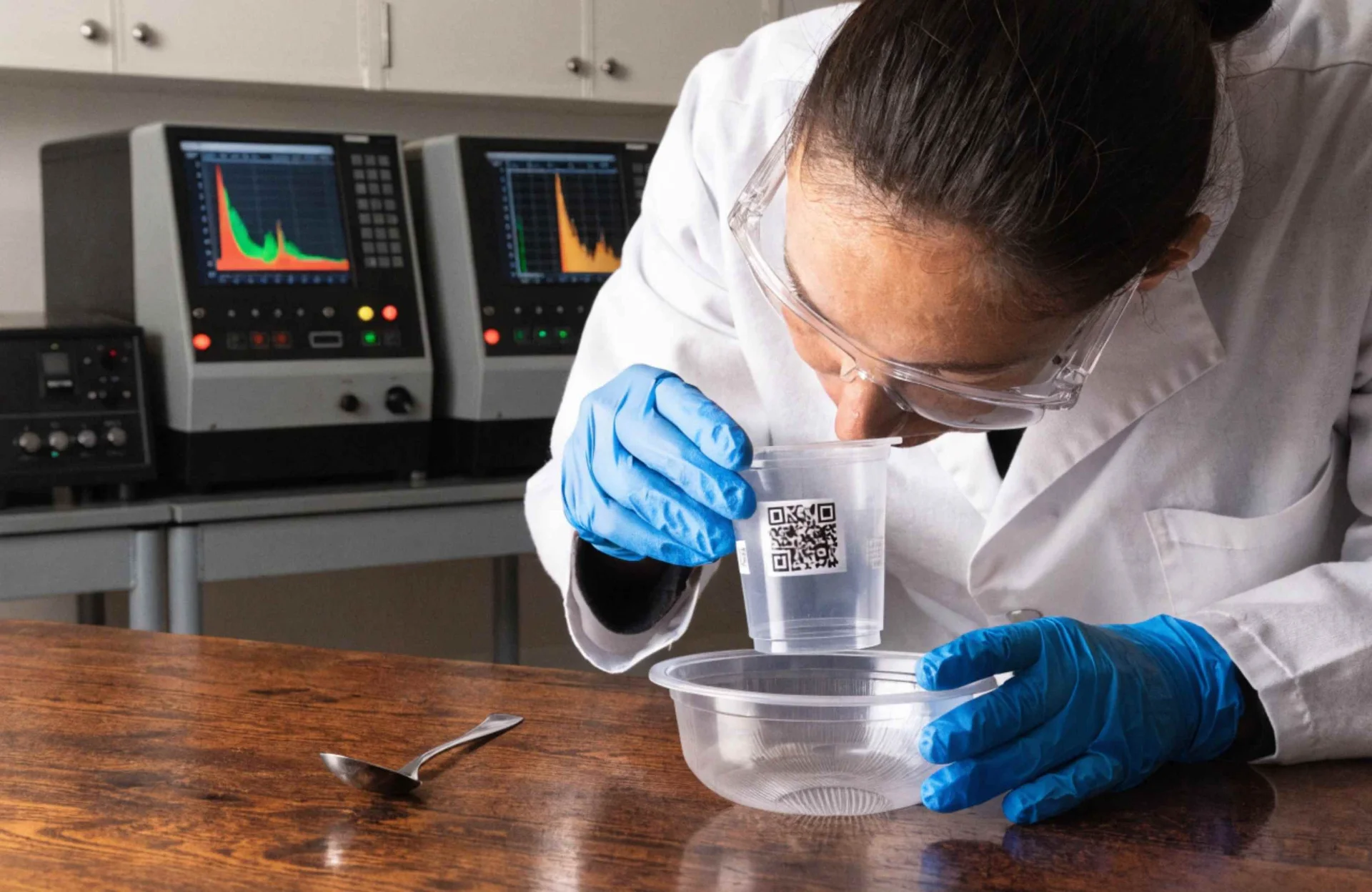
LFGB & TÜV Certification: The Gold Standard for European Market Access and Material Inertness
While general EU compliance is the baseline, serious B2B buyers require LFGB certification for the German and broader European markets. LFGB is notoriously strict, particularly regarding sensory evaluations. Under Section 30 and 31 of the LFGB framework, rPET tableware must undergo organoleptic testing to prove it does not alter the smell or taste of the food it touches. TÜV Rheinland or SGS typically conducts these tests. If the rPET manufacturing process leaves behind residual odors from the recycling stream, the product will fail LFGB testing instantly. Achieving this certification proves the plastic is functionally inert.
Challenge Testing: How Do We Simulate and Validate Contaminant Removal Under Worst-Case Scenarios?
To verify the effectiveness of a recycling process, material engineers utilize "challenge testing." Before full-scale production begins, a batch of PET flakes is intentionally spiked with chemical surrogates—such as toluene, chloroform, and phenylcyclohexane—which simulate highly toxic contaminants. The doped material is run through the thermal and vacuum decontamination systems. By measuring the concentration of these chemicals before and after the process, laboratories calculate the cleaning efficiency. The process is only approved for food-contact materials if the residual contamination drops well below the strict safety thresholds established by EFSA.
Supply Chain Traceability: How Can Material Pedigree Be Documented from Post-Consumer Bale to Finished Product?
Compliance is not a static achievement; it is a continuously tracked metric. Modern European regulations require robust traceability throughout the entire lifecycle of the material. As a direct source factory, we implement strict batch coding and ISO 9001-compliant tracking systems. We can trace every molded plate back to its specific batch of decontaminated rPET resin, and further back to the certified post-consumer bale. This level of material pedigree documentation is critical for European buyers dealing with customs audits, ensuring that every container of tableware shipped possesses a transparent, legally defensible chain of custody.
Shipment rejections at European borders frequently stem from failed customs compliance checks. Buyers often rely on outdated or generic material safety data sheets, only to find that their finished tableware leaches unapproved chemical compounds during transport or use. This gap between raw material documentation and finished product safety risks massive financial loss and dead inventory. Implementing a strict, batch-specific testing protocol for every production run prevents these compliance failures before containers ever leave the loading dock.
European food safety regulations do not just evaluate the raw polymer; they measure what happens to the finished product under thermal and chemical stress. Compliance requires passing Overall Migration Limits (OML) and Specific Migration Limits (SML) under EU EC 1935/2004, ensuring polymer additives do not transfer into food at levels exceeding 10 mg/dm².
![[Insert image here]](https://avecodinnerware.com/wp-content/uploads/2026/05/polymer-science-thermal-analysis.webp "![[Insert image here]")
Understanding the EU EC 1935/2004 Standard
The EU EC 1935/2004 framework establishes the baseline requirement that materials must not release constituents into food at levels harmful to human health. On the factory floor, this means strictly controlling the additives, colorants, and mold release agents used during injection molding. If a machine operator uses a non-food-grade silicone spray to release a stuck part, the entire batch risks failing compliance. We control this by utilizing high-polish CNC steel molds and optimized draft angles, entirely eliminating the need for chemical release agents. Furthermore, the standard requires full traceability. Every production batch must be linked back to specific raw material lot numbers, injection temperatures, and processing dates.
LFGB Testing and Migration Limits
German LFGB testing is notoriously strict, often serving as the benchmark for global food safety. It goes beyond basic water extraction tests. Tableware must endure exposure to 3% acetic acid, 10% ethanol, and olive oil at elevated temperatures—often 70°C for two hours—to simulate prolonged contact with acidic, alcoholic, and fatty foods. During manufacturing, if the polymer melt temperature is pushed too high to speed up cycle times, it degrades the molecular chains, increasing the likelihood of chemical migration during these LFGB tests. Maintaining polymer stability requires precise temperature calibration in the barrel and strict adherence to the resin's optimal processing window.
Selecting the Right Sustainable Polymers for Your Market
Aligning material specifications with end-user environments is a persistent challenge for commercial buyers. Specifying an incorrect polymer leads to catastrophic failures in the field, such as plates warping in commercial dishwashers or cups shattering upon impact. Material science dictates application limits. Choosing the correct substrate requires balancing thermal resistance, impact strength, and regulatory compliance to match the exact operational lifecycle of the tableware.
The thermal stability and durability of reusable tableware depend entirely on the crystallinity index and melt flow rate of the chosen polymer, which dictate whether a product will survive repeated industrial washing cycles or fail through environmental stress cracking.
![[Insert image here]](https://avecodinnerware.com/wp-content/uploads/2026/05/heat-resistance-test-plastic-bowls.webp "[Insert image here]")
The Performance Profile of Injection-Molded PP
Polypropylene (PP) remains a dominant material for reusable tableware due to its high fatigue resistance and excellent chemical stability. For food-contact applications, we utilize specific grades of random copolymer PP to achieve a balance of impact resistance and clarity, or block copolymers when rigidity is paramount. During injection molding, the cooling rate within the mold cavity determines the final crystalline structure of the PP. Uneven cooling causes internal stress, leading to warping later when the end-user washes the plate in hot water. By employing multi-zone temperature controllers on the mold, we ensure uniform shrinkage rates, resulting in dimensionally stable plates and bowls that maintain their structural integrity through hundreds of commercial wash cycles.
Bio-Based Alternatives: PLA and rPET Realities
Transitioning to bio-based or recycled polymers introduces complex processing variables. Polylactic Acid (PLA), while compostable under industrial conditions, possesses a low glass transition temperature (around 55°C to 60°C). Standard PLA will severely deform in a dishwasher. To counter this, manufacturers must utilize crystallized PLA (CPLA) and subject the molds to prolonged cooling cycles, which increases production time but yields a heat-resistant product. Conversely, recycled PET (rPET) offers excellent sustainability metrics but requires aggressive desiccant drying before processing. If moisture remains in the rPET pellets during extrusion, hydrolysis occurs, breaking down the polymer chains and resulting in brittle, easily fractured tableware.
| Material | Max Operating Temp | Dishwasher Safe | Impact Resistance | Primary Compliance Focus | Manufacturing Challenge |
|---|---|---|---|---|---|
| Polypropylene (PP) | 100°C - 120°C | Yes (Commercial) | High | EU 10/2011, LFGB | Managing shrinkage and warpage |
| Crystallized PLA (CPLA) | Up to 85°C | Yes (Residential) | Moderate | EN 13432, FDA | Extending mold cooling cycles |
| Recycled PET (rPET) | 60°C - 70°C | Hand wash only | Moderate to High | EFSA (Recycling Process) | Strict moisture control pre-molding |
Auditing a Direct Source Manufacturing Partner
Inconsistent product weights and hidden flash defects frequently plague buyers relying on opaque supply chains. Without direct visibility into the production environment, buyers are vulnerable to unauthorized material substitutions or degraded tooling. Verifying the physical machinery, the mold maintenance protocols, and the inline inspection systems is the only reliable method to guarantee consistent product output across multiple high-volume runs.
True production reliability relies on multi-cavity hot runner systems and automated moisture analysis to eliminate material degradation and ensure tight dimensional tolerances across tens of thousands of units.
![[Insert image here]](https://avecodinnerware.com/wp-content/uploads/2026/05/plastic-molding-machine.webp "[Insert image here]")
Assessing Precision Tooling Capabilities
The core of any injection molding operation is the tooling. Cheaply manufactured molds constructed from soft aluminum degrade rapidly under high clamping forces, leading to parting line mismatches and sharp edges (flash) on the tableware. A robust manufacturing facility invests in hardened steel molds (such as H13 or P20 steel) capable of withstanding millions of cycles without losing dimensional accuracy. When auditing a facility, examining the mold maintenance logs is critical. Routine cleaning of mold vents and inspection of ejector pins prevent gas burns on the plastic and ensure smooth part ejection. Furthermore, the use of hot runner systems minimizes material waste and prevents premature cooling of the melt, ensuring uniform density in the finished plate or cup.
Quality Control Across Production Batches
Quality control must be integrated into the active manufacturing process, not just treated as an afterthought at the packing station. We implement inline weigh scales to monitor shot consistency; a deviation of even a few grams indicates a fluctuation in melt pressure or a partially blocked mold cavity. Moisture analyzers test the raw resin before it enters the hopper, ensuring it meets the strict ppm limits required for defect-free molding. Additionally, samples from every shift undergo destructive testing—including drop tests from specific heights and thermal shock tests—to verify that the physical properties match the approved baseline. This data-driven approach removes subjectivity from quality assurance, guaranteeing that the ten-thousandth unit performs exactly like the first.
Final. Conclusion: Sustainable food-grade tableware requires strict adherence to polymer science, precise injection molding parameters, and rigorous FCM compliance testing. By understanding thermal thresholds, tooling quality, and migration limits, buyers can secure durable, regulatory-compliant products that perform reliably in demanding commercial environments without compromising safety.