
European buyers are tightening supply chains. Claiming your tableware uses recycled plastics without verifiable data exposes your procurement line to compliance failures, heavy plastic taxes, and sudden import rejections at the border.
GRS (Global Recycled Standard) certification acts as the primary validation tool for verifiable recycled content, chain of custody tracking, and chemical safety compliance. For EU importers, obtaining a GRS-certified Transaction Certificate (TC) directly dictates whether your shipments clear customs and qualify for plastic tax exemptions.

In manufacturing, processing tons of rPET and bioplastics daily under stringent EU EC 1935/2004 frameworks requires absolute structural discipline. Navigating the intersection of food-contact safety and audited sustainability is not a marketing exercise; it is an engineering and operational reality. Here is the unvarnished factory perspective on securing a verifiable recycled supply chain.
1. The Full Picture of GRS Certification: Defining the "Green Passport" for Recycled Plastics
You ask a supplier for recycled material, and they hand you an unverified internal spec sheet. That document holds zero legal weight during an EU customs audit or a brand compliance check.
GRS requires rigorous third-party auditing to confirm that recycled inputs match production outputs. It establishes strict parameters, ensuring rPET tableware meets both structural integrity limits and international chemical restrictions.
1.1 What is GRS? – From a "Nice-to-Have" to a "Must-Have" Standard
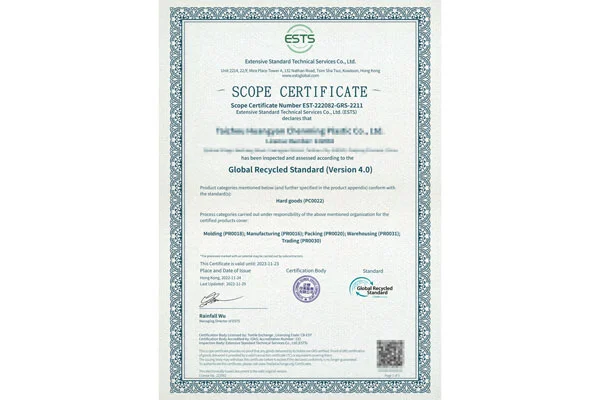
The Global Recycled Standard is an international, voluntary, full product standard that sets requirements for third-party certification of recycled content, chain of custody, social and environmental practices, and chemical restrictions. For tableware manufacturers, processing recycled polyethylene terephthalate (rPET) inherently involves tracking the Intrinsic Viscosity (IV) drops during thermal cycling. GRS adds the mandatory documentation layer over this material science. It is no longer just a premium badge; as European plastic taxes target virgin polymers, GRS has become the baseline legal defense for proving the origin of Post-Consumer Recycled (PCR) and Post-Industrial Recycled (PIR) inputs.
1.2 Who Needs GRS? – The "Chain-of-Custody" Mechanism Across the Supply Chain
Every entity that takes legal ownership of the material must be certified. This means the pellet extruder, the injection molding factory, the assembly plant, and the final exporter must all hold valid scope certificates. If a tableware factory buys certified rPET resin but lacks its own GRS certification, the chain is broken. The resulting food containers cannot be sold as GRS-certified. This chain-of-custody mechanism prevents non-compliant actors from washing virgin plastics into the sustainable supply chain.
1.3 GRS vs. RCS: "20% for Entry, 50% for Labeling"
Many buyers confuse GRS with the Recycled Claim Standard (RCS). While both track recycled inputs, their thresholds and operational demands differ significantly. To bear the GRS logo—which frequently commands a 15% to 30% premium at European retail—a product must contain at least 50% recycled content.
| Feature | Global Recycled Standard (GRS) | Recycled Claim Standard (RCS) |
|---|---|---|
| Minimum Recycled Content | 20% to certify, 50% for on-product logo | 5% to certify and label |
| Chemical Restrictions | Strict restrictions on hazardous chemicals | None explicitly mandated by standard |
| Environmental Audits | Mandatory (energy, water, waste tracking) | Not required |
| Social Criteria Audits | Mandatory (labor rights, safety) | Not required |
| Best Application | High-end B2B procurement, tax exemptions | Basic recycled content verification |
1.4 GRS Version 4.0: Key Requirements for Companies to Note
The current iteration, GRS 4.0, forces manufacturers to integrate Zero Discharge of Hazardous Chemicals (ZDHC) guidelines. For food-contact tableware, this intersects heavily with migration limits under LFGB and FDA regulations. We must prove that no restricted chemical substances were introduced during the washing, shredding, or extrusion of the rPET flakes. Furthermore, version 4.0 scrutinizes factory energy consumption and wastewater discharge, making it impossible for a technologically outdated facility to pass the audit, regardless of their material sourcing.
2. From "Certified" to "Verifiable": The Traceability System in GRS Certification
A certificate on a wall means nothing if the material on the production line is a blended mess. Commingling virgin and recycled resin off-record destroys batch integrity and voids compliance.
Verifiable traceability demands total physical and documentation separation. Auditors trace purchase orders, mass balance calculations, and specific silo storage to guarantee that the declared percentage of PCR material accurately matches the finished goods.

2.1 Core Logic of Traceability: The Four "Musts"
Traceability on the factory floor relies on absolute mathematical certainty. A facility must identify the certified material at receiving, must segregate it during drying and molding, must calculate the mass balance formula for every production run, and must track output volumes against input invoices. If we purchase 10 metric tons of GRS-certified rPET pellets, the physical laws of injection molding dictate shrinkage and runner regrind. We cannot mathematically output 11 tons of finished GRS tableware.
2.2 How Does Full-Chain Traceability Work?
Full-chain traceability links raw material lot numbers directly to finished good serial numbers. When an EU client orders a batch of reusable rPET plates, our enterprise resource planning (ERP) system allocates a specific batch of GRS resin. The temperature profiles, molding cycles, and material draw-down rates are logged. This data package ensures that if a European regulatory body pulls a plate from a shelf for chemical migration testing, we can trace its molecular origin back to the specific recycling facility that supplied the flakes.
2.3 Why Does a Certificate Not Guarantee Shipment? – Five Key Checkpoints in On-Site Audits
Holding a Scope Certificate (SC) does not give a supplier a blank check to ship goods. Certifying bodies conduct stringent unannounced or scheduled audits targeting five specific checkpoints: raw material purchase invoices, inventory ledger accuracy, daily production logs, shipping records, and real-time energy consumption data. Discrepancies between the energy used by injection molding machines and the claimed production volume of recycled tableware will immediately flag a facility for mass balance fraud.
3. Transaction Certificate (TC): The "Quota Transfer Document" in the GRS System
Buyers often assume the supplier’s annual scope certificate covers their specific order automatically. They only realize their error when the shipment arrives and customs demands specific batch clearance.
A Transaction Certificate (TC) is a batch-specific document proving the exact volume of certified material transferred between parties. Without a valid TC, the final product cannot be legally sold, labeled, or taxed as a GRS-certified good.
3.1 GRS Certificate ≠ TC: The Former is a "Qualification", the Latter is a "Passport"
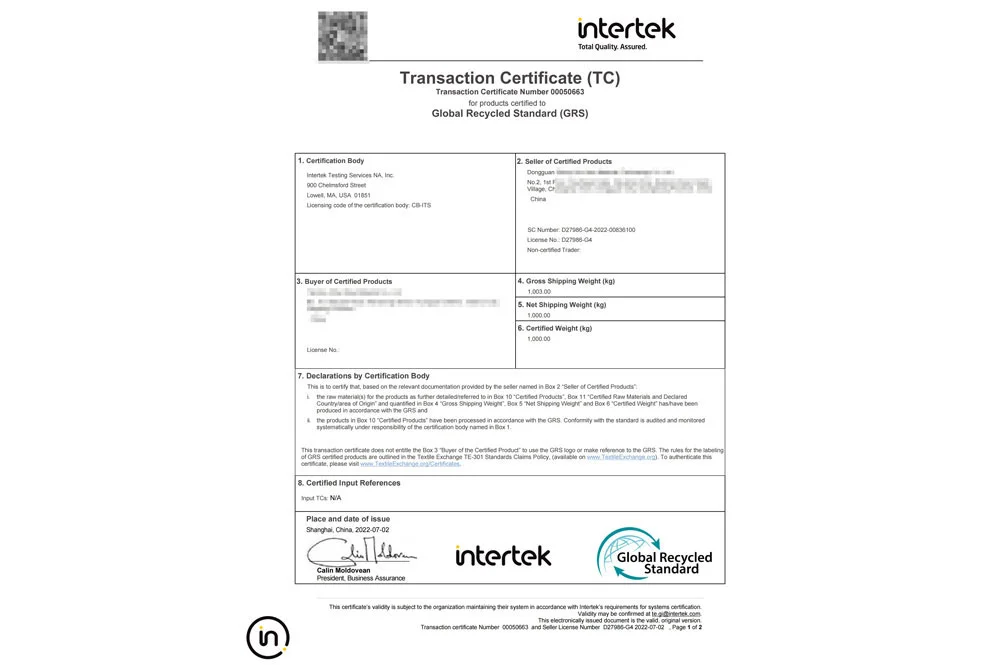
A Scope Certificate (SC) simply proves that a factory has the physical and administrative capability to produce GRS goods. It is a qualification. The Transaction Certificate (TC), however, is the actual passport for the goods in transit. When procuring rPET tableware, purchasing managers must demand a TC for their specific purchase order. The SC shows the factory is legally allowed to drive; the TC proves they paid the toll for your specific cargo.
3.2 The Essence of TC: A "Digital Dossier of Recycled Material" from Source to End Product
The TC serves as an immutable digital dossier. It logs the net weight of the certified product, the specific material composition (e.g., 80% Post-Consumer Recycled PET, 20% Virgin PET), and the origin of the inputs. Certifying bodies issue the TC only after verifying that the factory’s input volume of certified raw material adequately covers the output volume being shipped to the buyer. It eliminates the risk of double-counting sustainable materials.
3.3 How Is a TC Issued? – "Audit-Grade" Documentation from Upstream Suppliers
To generate a TC for a buyer, the tableware manufacturer must submit a comprehensive documentation package to the certifying body. This includes the input TCs from the pellet supplier, internal production records, mass balance calculations, and commercial invoices. The certification body audits this data. Because this process involves third-party verification, it takes time. Astute procurement teams build a 14-to-30-day buffer into their logistics timelines strictly for TC issuance.
3.4 Practical Pitfalls: "If You Can't Issue a TC, Your Supply Chain Breaks"
A severe breakdown occurs when a factory accepts an order for GRS tableware but fails to secure input TCs from their raw material supplier. Without the upstream TC, the factory's mass balance calculation collapses. They cannot issue the final TC to the European buyer. Consequently, the buyer’s goods arrive at the port lacking sustainable verification, forcing the importer to pay steep virgin plastic taxes or face immediate breach of contract with their own retail distributors. Verifying the supplier's historical ability to successfully generate TCs is a non-negotiable step in the procurement process.
Beyond GRS: EN 15343, ISCC PLUS and ISO 22095 – The Multi-Certification Layout for rPET Exports to the EU
Relying solely on GRS leaves your compliance architecture incomplete when navigating specific European tax codes. Different EU member states demand highly specific, localized standards to legally validate recycled content, and ignoring these secondary frameworks invites stalled customs clearances or massive tax penalties upon importation.
A robust compliance framework requires stacking specific certifications based on polymer origin and regional laws. GRS verifies supply chain mass balance and ethics, while EN 15343 provides the strict legal basis for plastic tax exemptions in countries like Spain. For advanced chemical recycling intended for direct food contact, ISCC PLUS governs molecular-level traceability.

4.1 EN 15343: From a Brand Threshold to a Mandatory "Legal Measurement Tool"
Standard UNE-EN 15343 has transitioned from an optional environmental badge to a hard legal requirement. In Spain, for example, the government levies a €0.45 per kilogram tax on non-reusable plastic packaging. To claim an exemption based on recycled content, customs authorities do not accept self-declarations; they legally require certification under EN 15343. This standard dictates precise operational procedures for plastics recycling traceability and assessment of conformity. For a factory, this means our extrusion and molding data must align perfectly with EN 15343 audit protocols, calculating exact melt-flow index variations and batch weights to satisfy European tax auditors.
4.2 GRS vs. EN 15343: How "Supply Chain Pass" and "Tax Relief Qualification" Work Together
While GRS and EN 15343 both track recycled inputs, their operational endpoints differ entirely. A sophisticated B2B buyer needs both. GRS secures brand trust and satisfies corporate retail standards. EN 15343 serves as the quantitative tool used by government tax agencies.
| Standard | Primary Function | Audit Focus | Key Benefit for B2B Importers |
|---|---|---|---|
| GRS | Chain of Custody & Ethics | Mass balance, social/environmental criteria | Meets retailer sustainability mandates, enables premium logo usage. |
| EN 15343 | Regulatory Compliance | Traceability of physical recycling processes | Serves as the strict legal basis for EU plastic tax exemptions. |
| ISCC PLUS | Advanced Material Tracking | Chemical/molecular recycling mass balance | Clears food-contact hurdles for chemically recycled bio-plastics. |
4.3 ISCC PLUS Certification: The "Fast Track" for Chemically Recycled rPET into Food Contact Applications
Mechanical recycling of rPET into food-contact tableware faces intense scrutiny under EU EC 1935/2004 due to the risk of chemical migration from legacy additives. Chemical recycling bypasses this by depolymerizing the plastic back to its monomer state, removing contaminants entirely. However, tracing monomers requires complex accounting. ISCC PLUS (International Sustainability and Carbon Certification) is the framework that tracks these chemically recycled inputs through a mass balance approach. When we inject chemically recycled resins, ISCC PLUS documentation proves to the auditor that the raw material is inherently safe for high-heat food contact, effectively fast-tracking regulatory approval.
4.4 ISO 22095: The "Basic Framework" for Material Traceability
ISO 22095 establishes the overarching terminology and models for chain of custody. It defines whether a supply chain operates on identity preservation, segregation, mass balance, or a book-and-claim model. On the factory floor, we use the principles of ISO 22095 to structure our ERP software. By standardizing how we define material routing, this framework ensures our internal tracking easily translates into the specific data formats demanded by GRS, ISCC PLUS, or EN 15343 auditors.
Certification Dividends: How GRS Translates into Tariffs, Tax Rates and Brand Premium
Processing Post-Consumer Recycled (PCR) material introduces thermal degradation challenges, requiring specialized drying equipment and slower injection molding cycle times. Procurement teams often struggle to justify these elevated manufacturing costs when strictly comparing initial factory quotes against cheap virgin polymer equivalents.
The tangible return on investment for certified recycled tableware materializes downstream. Valid certifications directly offset European plastic taxes, which often run €450 per metric ton. Furthermore, correctly labeled GRS products consistently command a 15% to 30% price premium at retail, fundamentally transforming the profitability equation for B2B importers.

5.1 Policy Dividends: From Tariff Reductions to Plastic Tax Exemptions
The European Union's aggressive regulatory stance means virgin plastics are actively penalized. By procuring GRS and EN 15343 certified rPET tableware, importers shield themselves from these accumulating costs. The Spanish plastic tax of €0.45/kg translates to €450 for every metric ton of imported tableware. If a buyer ships ten containers of virgin PP plates, the tax burden heavily degrades their margin. Verifiable PCR content, backed by a Transaction Certificate, neutralizes this tax entirely. The upfront cost of certified manufacturing is absorbed by the immediate savings at customs.
5.2 Achieving Commercial Breakthroughs Through Certification
Premium foodservice operators and enterprise coffee chains no longer issue open tenders to generic suppliers. Their procurement systems require suppliers to upload valid Scope Certificates before a Request for Quotation (RFQ) can even be generated. Holding GRS certification grants access to these restricted procurement pools. Factories that maintain strict compliance standards bypass the race-to-the-bottom pricing wars of uncertified commodities, aligning instead with buyers who require guaranteed regulatory safety for their commercial expansion.
5.3 Understanding the Business Value of GRS with Three Data Sets
We measure the impact of certified supply chains through concrete operational data. First, the 50% GRS threshold: Tableware containing at least 50% verifiable recycled content qualifies for the on-product GRS logo, enabling significant brand differentiation. Second, the €0.45/kg tax benchmark: In regulated markets, compliance yields immediate, measurable operational savings. Third, order volume retention: Industry case data shows that companies securing GRS verification often triple their order volumes from enterprise buyers within 24 months, as they win exclusive supplier status to replace non-compliant vendors.
A Guide for Premium Foodservice Procurement: How GRS Certification Helps Purchasing Managers Lower Risk and Enhance Brand Value
Procuring food-grade rPET requires absolute engineering discipline. Blindly purchasing recycled tableware without auditing the manufacturer's chemical migration data, Intrinsic Viscosity controls, and traceability protocols will inevitably trigger customs seizures or disastrous product recalls.
Safe procurement demands technical scrutiny. Buyers must strictly enforce migration testing under EU 10/2011, demand batch-specific Transaction Certificates (TCs) prior to shipment, and visually verify that the factory segregates PCR inputs from virgin resins across the production floor.

6.1 Four "Procurement Red Lines" for Foodservice Operators
Purchasing managers must establish non-negotiable operational boundaries. Red line one: Refuse shipment if the supplier cannot produce a batch-specific TC. Red line two: Reject any recycled tableware that lacks third-party heavy metal and specific migration limit (SML) testing. Red line three: Avoid manufacturers who cannot disclose the physical origin of their PCR flakes. Red line four: Disqualify factories that mix virgin and recycled resins in the same drying hoppers without documented purging protocols, as this destroys the mass balance integrity.
6.2 Procurement Checklist: "5 Questions to Ask rPET Tableware Suppliers to Avoid Non-Compliance and Supply Disruptions"
To audit a factory’s technical capability, ask these exact questions during the RFQ process.
- What is your acceptable Intrinsic Viscosity (IV) drop limit during rPET extrusion, and how do you test it?
- Can you provide photographic evidence of your segregated PCR material silos and dedicated injection molding lines?
- What is your historical lead time for generating a Transaction Certificate (TC) after a production run is complete?
- How do you ensure Zero Discharge of Hazardous Chemicals (ZDHC) compliance when washing and processing your raw PCR flakes?
- Do you conduct in-house thermal stability testing to guarantee the recycled plates survive commercial dishwasher cycles without warping?
6.3 Key 2026 Regulatory Deadlines: Two Major Laws Taking Effect
The regulatory window for voluntary compliance is closing. On August 12, 2026, the EU Packaging and Packaging Waste Regulation (PPWR) fully takes effect, mandating aggressive recycled content targets and strict recyclability assessments for all packaging and foodservice items entering the bloc. Concurrently, broader revisions to the EU Waste Framework Directive will enforce extended producer responsibility (EPR) fees based heavily on verified recycled content. Buyers who fail to establish robust, certified rPET supply lines now will face severe supply disruptions when these deadlines trigger automatic customs enforcement.
GRS and rPET Tableware: Aveco’s Solution
Transitioning a commercial foodservice line from virgin polymers to compliant rPET involves navigating extremely narrow thermal processing windows. Standard injection molding factories lack the atmospheric controls and engineering precision required to stabilize recycled polymers for high-heat food contact.
At Aveco, precision manufacturing neutralizes polymer degradation. We tightly control rPET Intrinsic Viscosity (IV) drops during extrusion to preserve structural strength, guaranteeing our tableware clears strict LFGB and EU EC 1935/2004 migration tests while maintaining an unbroken, audit-ready GRS chain of custody.
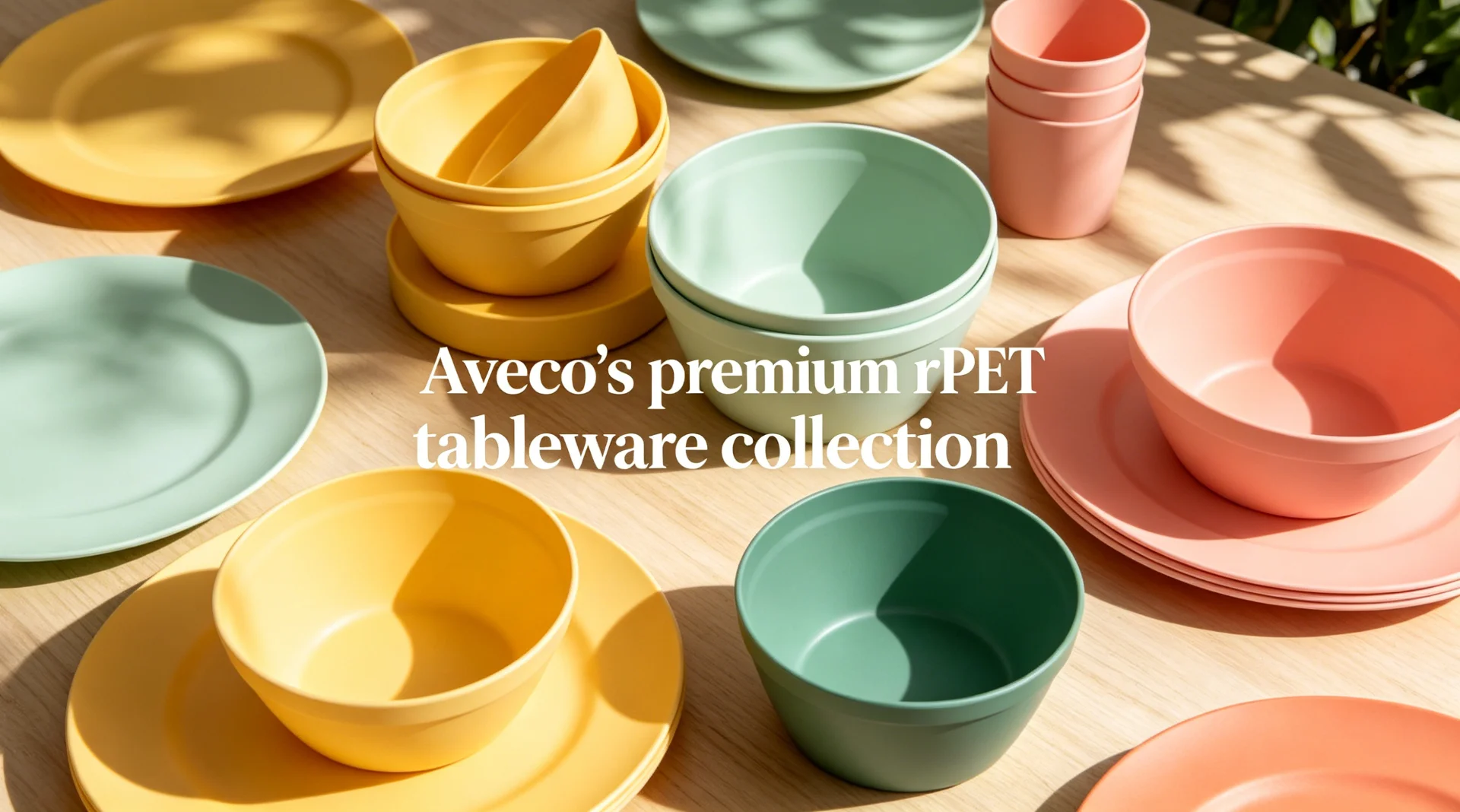
Our production floors operate under strict physical segregation. Dedicated desiccant drying systems ensure our PCR inputs remain free from moisture hydrolysis, which commonly causes brittleness in inferior recycled tableware. By controlling the melt temperature and injection pressure at a microscopic level, we produce rPET plates and bowls that withstand aggressive commercial washing cycles. Backed by material science engineers, our internal compliance team manages the entire mass balance calculation process, ensuring downstream buyers receive their TCs without logistical delays. We bridge the gap between heavy-duty food safety requirements and stringent European environmental taxation laws.
Conclusion: In the Green Certification Race, Early Movers Win
Verified traceability and chemical safety determine survival in the European tableware market. Securing GRS, EN 15343, and stringent food-contact documentation shields supply chains from tax penalties and customs rejections. Aligning with an engineered, audit-ready manufacturing source guarantees long-term compliance and operational stability.